

Persistent business-cycle dynamics

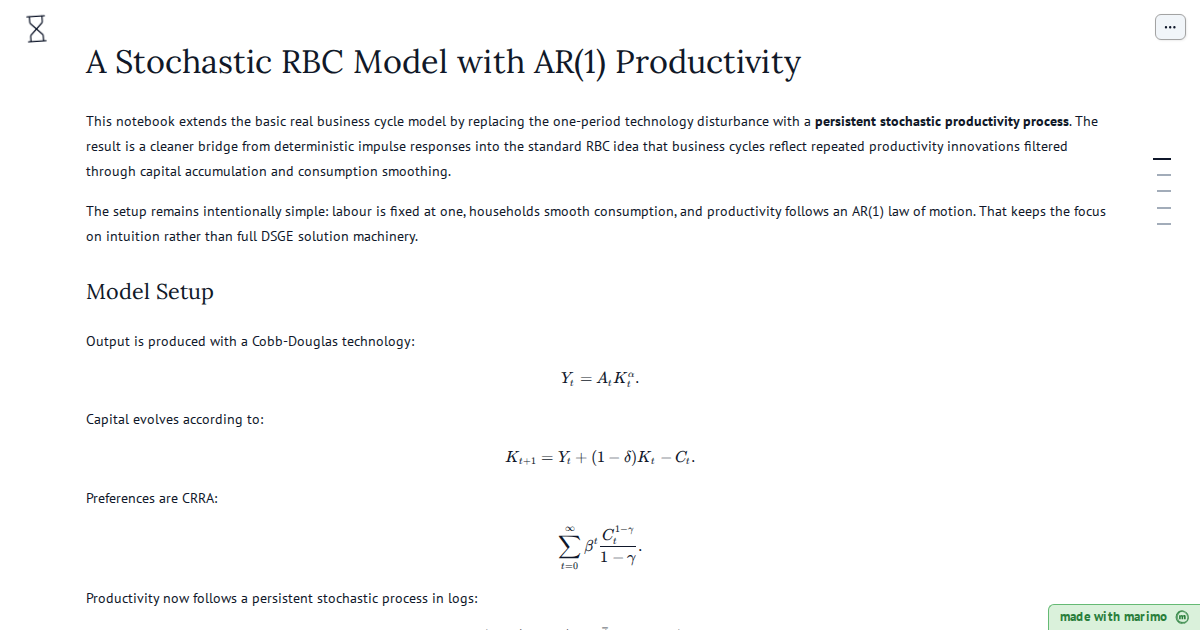
Stochastic RBC Model with AR(1) Shocks

An RBC notebook with persistent AR(1) productivity shocks, showing how repeated stochastic disturbances interact with consumption smoothing and capital accumulation.

Macroeconomics Business cycle Advanced EasyEcon / Marimo Growth, business cycles, and open economy
Focus

AR(1) productivity, stochastic simulation, and propagation

Vary shock persistence, innovation volatility, and core preference parameters to see how a stochastic TFP process generates realised paths and sample moments for output, consumption, and investment.

What to explore

Change parameters and watch the model adjust.

  • Capital share, discount factor, risk aversion, depreciation, baseline TFP, shock persistence, and innovation volatility
  • Initial capital, simulation horizon, and random seed for realised shock paths

Core ideas

Interpret the mechanics before you chase the graphs.

  • AR(1) shocks provide a benchmark way to model persistent productivity fluctuations.
  • Consumption remains smoother than output and investment because households spread shocks intertemporally.
  • Stochastic RBC is the flexible-price benchmark that typically precedes New Keynesian models.

Learning goals

What this model should help students internalize.

  • See how persistent AR(1) productivity shocks differ from one-period deterministic disturbances.
  • Interpret why output inherits both exogenous shock persistence and endogenous propagation through capital.
  • Compare the relative volatility of consumption, investment, and output in a stochastic RBC environment.

Prerequisites

Concepts to review before diving in.

  • Basic RBC intuition and Euler-equation reasoning
  • Comfort with capital accumulation and simple stochastic processes

EasyEcon interactive

Stochastic RBC notebook

EasyEcon / Marimo

On phones, the full-screen view gives the cleanest notebook reading experience.

Open full screen

Deferred notebook load

AR(1) productivity, stochastic simulation, and propagation

Vary shock persistence, innovation volatility, and core preference parameters to see how a stochastic TFP process generates realised paths and sample moments for output, consumption, and investment.

Open full screen
The EasyEcon Marimo/WASM bundle loads only when requested or when the panel scrolls near view on fast connections.

Next models to study

Keep moving through the track.