What to explore
Change parameters and watch the model adjust.
- Shock type, Phillips-curve slope, intertemporal demand sensitivity, and Taylor-rule coefficients
- Shock persistence, shock size, and horizon for deterministic impulse responses
Sticky-price business-cycle dynamics
A Gali-style three-equation DSGE notebook combining the dynamic IS curve, New Keynesian Phillips curve, and a Taylor rule to study inflation-output stabilisation under nominal rigidities.
Taylor-rule stabilisation, sticky prices, and policy trade-offs
Adjust Phillips-curve slope, intertemporal demand sensitivity, policy-rule coefficients, and shock persistence to see how inflation, the output gap, and interest rates respond.EasyEcon interactive
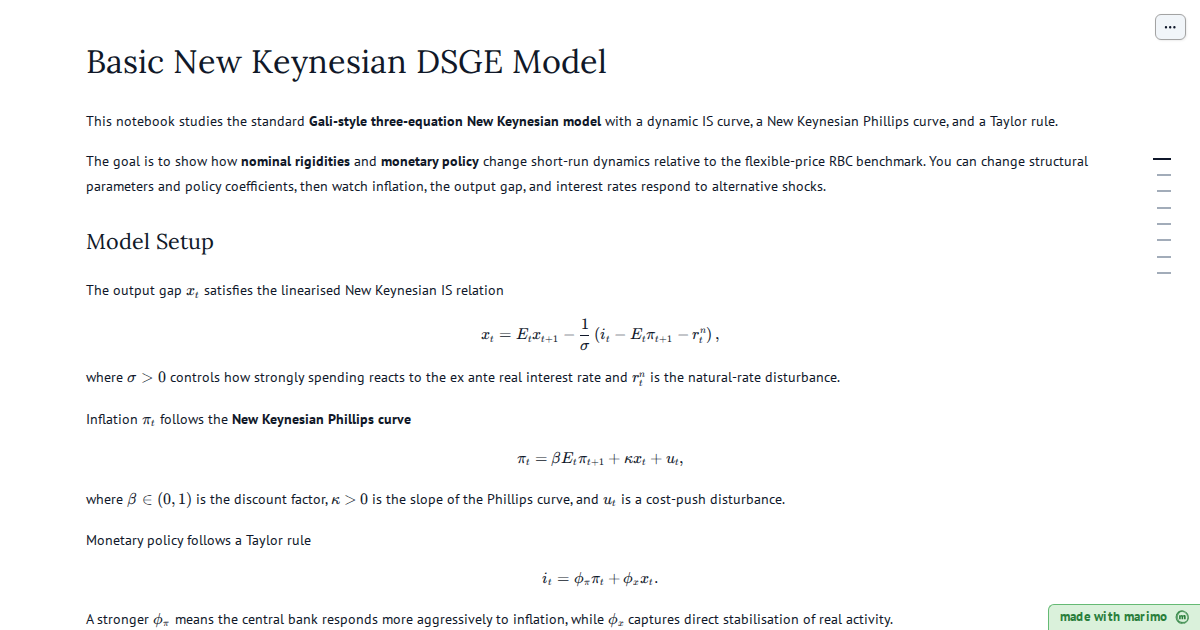
Adjust Phillips-curve slope, intertemporal demand sensitivity, policy-rule coefficients, and shock persistence to see how inflation, the output gap, and interest rates respond.
The EasyEcon Marimo/WASM bundle loads only when requested or when the panel scrolls near view on fast connections.The notebook couldn’t load. It may be a slow connection or a temporary problem.
Macroeconomic growth and cycles
What to explore
Core ideas
Learning goals
Prerequisites
Newsletter
Next models to study
Advanced macroeconomics
Explore how productivity shifts, world interest rates, and impatience shape consumption, external borrowing, and the current account over time.
Advanced macroeconomics
Change technology, saving, and policy wedges to see how the growth rate of capital, output, and consumption can remain permanently elevated.