
What to explore
Change parameters and watch the model adjust.
- Capital share, discount factor, risk aversion, depreciation, baseline TFP, and one-period shock size
- Initial capital and simulation horizon for deterministic impulse responses
Deterministic business-cycle dynamics
A stripped-down RBC notebook where a representative household smooths consumption after a temporary productivity shock, generating impulse responses in output, investment, and capital.
Temporary TFP shocks, impulse responses, and propagation
Change preferences, technology, depreciation, and shock size to see how a one-period TFP disturbance propagates through a closed economy with endogenous saving.EasyEcon interactive
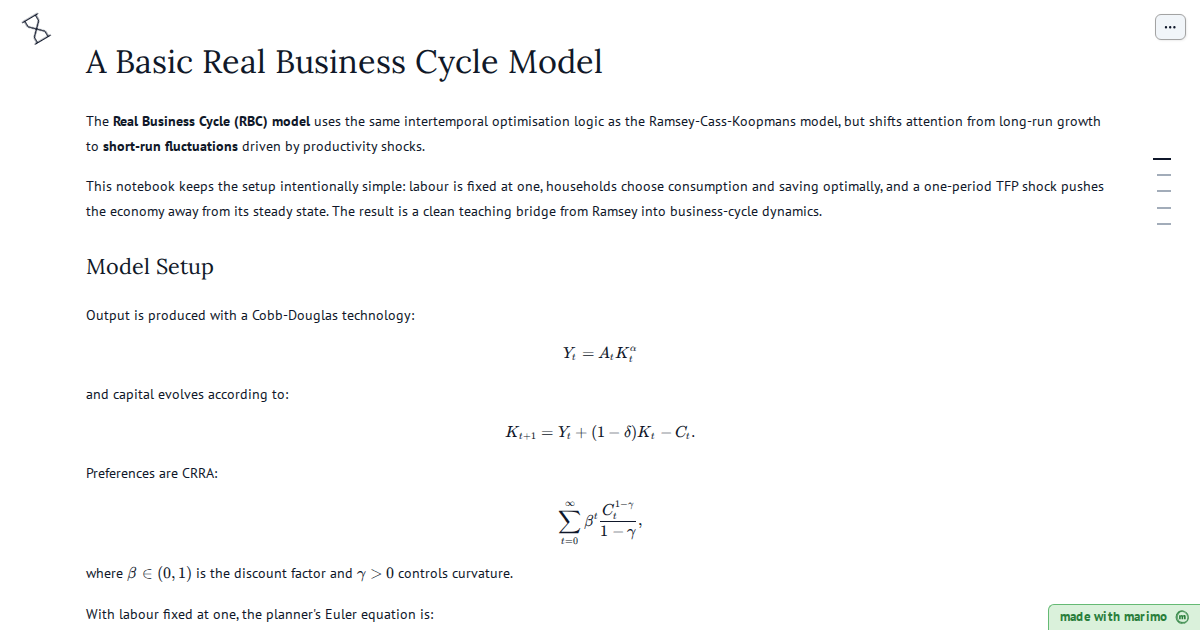
Change preferences, technology, depreciation, and shock size to see how a one-period TFP disturbance propagates through a closed economy with endogenous saving.
The EasyEcon Marimo/WASM bundle loads only when requested or when the panel scrolls near view on fast connections.The notebook couldn’t load. It may be a slow connection or a temporary problem.
Macroeconomic growth and cycles
What to explore
Core ideas
Learning goals
Prerequisites
Newsletter
Next models to study
Persistent business-cycle dynamics
Vary shock persistence, innovation volatility, and core preference parameters to see how a stochastic TFP process generates realised paths and sample moments for output, consumption, and investment.
Advanced macroeconomics
Explore how productivity shifts, world interest rates, and impatience shape consumption, external borrowing, and the current account over time.