What to explore
Change parameters and watch the model adjust.
- True treatment effect, baseline group gap, common trend, trend violation, noise, and cell size
- The panel is simulated with a fixed seed so treatment and bias move predictably
Upper-undergraduate econometrics
A two-group, two-period panel notebook for treatment effects, common trends, and what happens when parallel trends fail.
Parallel trends, group means, and treatment-effect decomposition
Adjust treatment effects, group gaps, noise, and trend violations to see exactly when the DiD estimate matches the truth and when it drifts.EasyEcon interactive
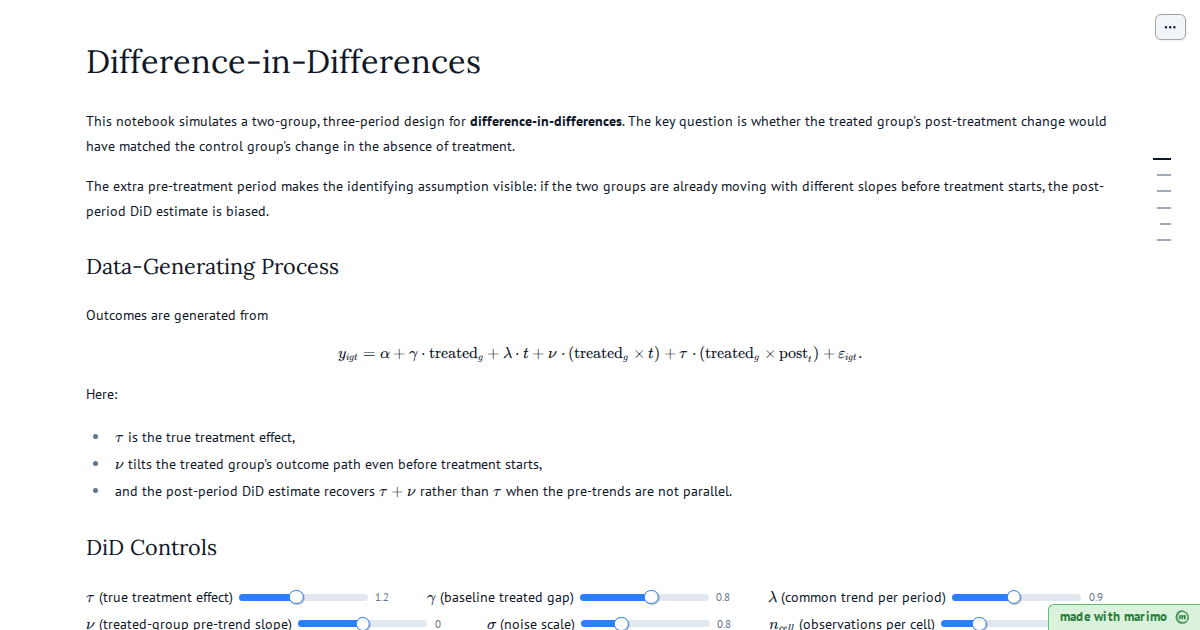
Adjust treatment effects, group gaps, noise, and trend violations to see exactly when the DiD estimate matches the truth and when it drifts.
The EasyEcon Marimo/WASM bundle loads only when requested or when the panel scrolls near view on fast connections.The notebook couldn’t load. It may be a slow connection or a temporary problem.
Econometrics and causal inference
What to explore
Core ideas
Learning goals
Prerequisites
Newsletter
Next models to study
Upper-undergraduate econometrics
See when IV improves on OLS, when weak instruments make the estimate unstable, and how exclusion violations undermine the design.
Intermediate causal inference
See how a discontinuity identifies a causal effect: fit a line each side of the cutoff and read the vertical jump between them, then watch the bandwidth trade bias against noise.
Intermediate price theory
See how a per-unit tax alters prices on both sides of the market and divides the burden between buyers and sellers.